|
|
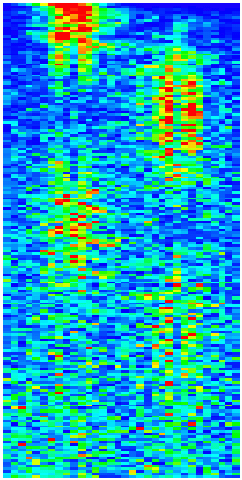
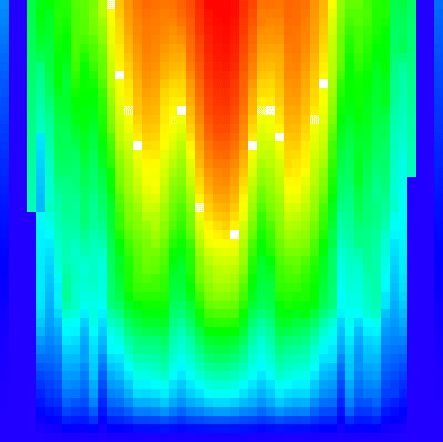
 Schrodinger cat animated on a quantum computer
Time evolution of the Schrodinger cat:
probability distribution W(x) at -3.14 < x < 3.14 is shown
for different number of map iterations t, changing along y-axis
from t=0 (top) to t=180 (bottom).
Here for the double well map K=0.04, a=1.6 and
hbar = 4 x 3.1415/N with N=32. Quantum computation is done
with 6 qubits and and noisy gates of noise strength eps = 0.02,
and 2090 gates per one map iteration.
At t=0 initial coherent packet is located at x=-a.
From Ref. 131
http://xxx.lanl.gov/abs/quant-ph/0202113
|
|
|
|
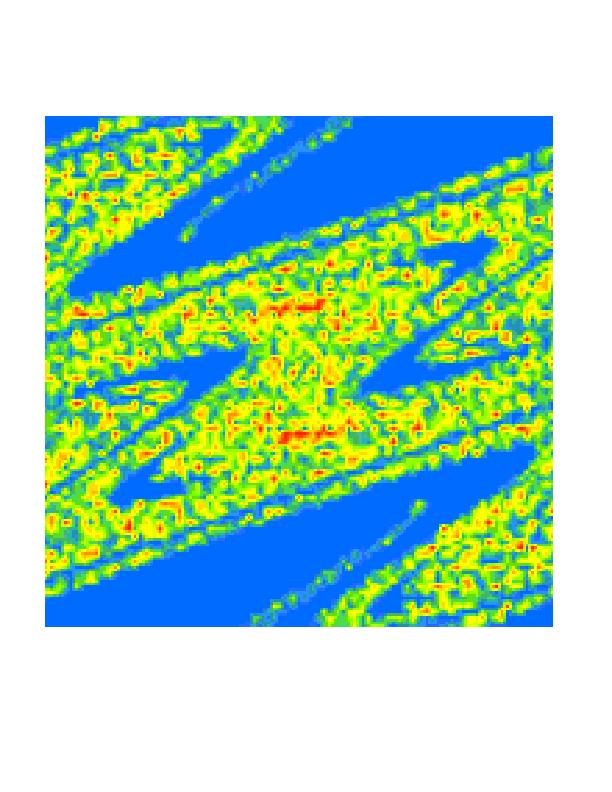
Quantum
fractal survivor
Quantum fractal eigenstate (Husimi function)
with minimal decay rate in the open
quantum kicked rotator with the chaos parameter K=7;
probability is absorbed outside of box size N=59049,
kick strength k=N/4.
From Ref. 97 (Physica D 131 (1999) 311)
http://xxx.lanl.gov/abs/cond-mat/9710118
|
|
|
|
|
Quantum
chaos & quantum computers
Quantum computer melting induced by the
coupling between qubits. Color represents the level of
quantum eigenstate entropy Sq
(blue - minimal Sq=0, red - maximal Sq=11)
for 12 qubits. Vertical axis gives the coupling
strength, horizontal one gives the energy of
computer eigenstate.
From Ref. 107 (1999)
http://xxx.lanl.gov/abs/quant-ph/9909074
|
|
|
|
|
|
|
|
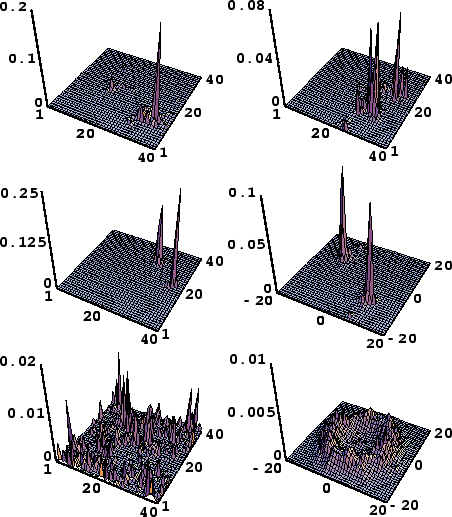
Delocalization of
two-particle ring
near the Fermi level of 2d Anderson model
Probability distributions f and f_d for TIP in 2d disordered
lattice of size L=40, and interaction of radius R=12 and
width dR = 1. Left column, one-particle probability f
for W=8V: ground state at U=0 (top); ground state with binding
energy E = -1.05 V at U=-2V (middle); coupled state with
E = -0.19 V at U=-2V (bottom). Right column:
f for coupled state, compare to bottom left, at W=12V
and U=-2V with E = -0.19 V(top); inter-particle
distance probability f_d related to the middle left case (middle);
f_d related to the bottom left case (bottom). All data are
shown for the same disorder realisation.
From Ref. 110 (2000)
http://xxx.lanl.gov/abs/cond-mat/0002296
|
|
|
|
|
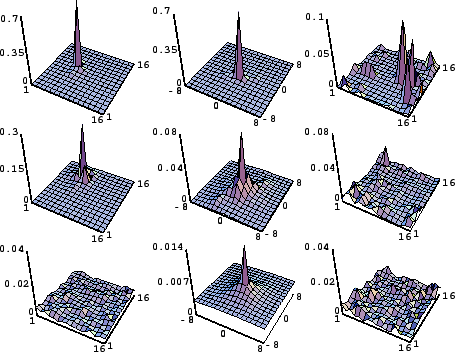
Generalized
Cooper problem in the vicinity of Anderson transition
Probability distributions for two interacting particles
in the 3d Anderson model at the ground state. Probability
is projected on (x,y)-plane: one particle probability f_p
for Hubbard interaction U=-4 V (left column),
interparticle distance probability f_pd for U=-4 V (centrum
column), f_p for U=0 (right column); the disorder strength is
W/W_c=1.1 (upper line), W/W_c=0.5 (middle line), W/W_c=0.3
(bottom line); W_c=16.5 V is the critical disorder for
Anderson transition at half filling.
All data are given for the same realisation of disorder
for the system size L=16. Upper line corresponds to
the insulating noninteracting phase while two others are
in the metallic one at U=0.
From Ref. 109 (1999)
http://xxx.lanl.gov/abs/cond-mat/9911461
|
|
|
|
|
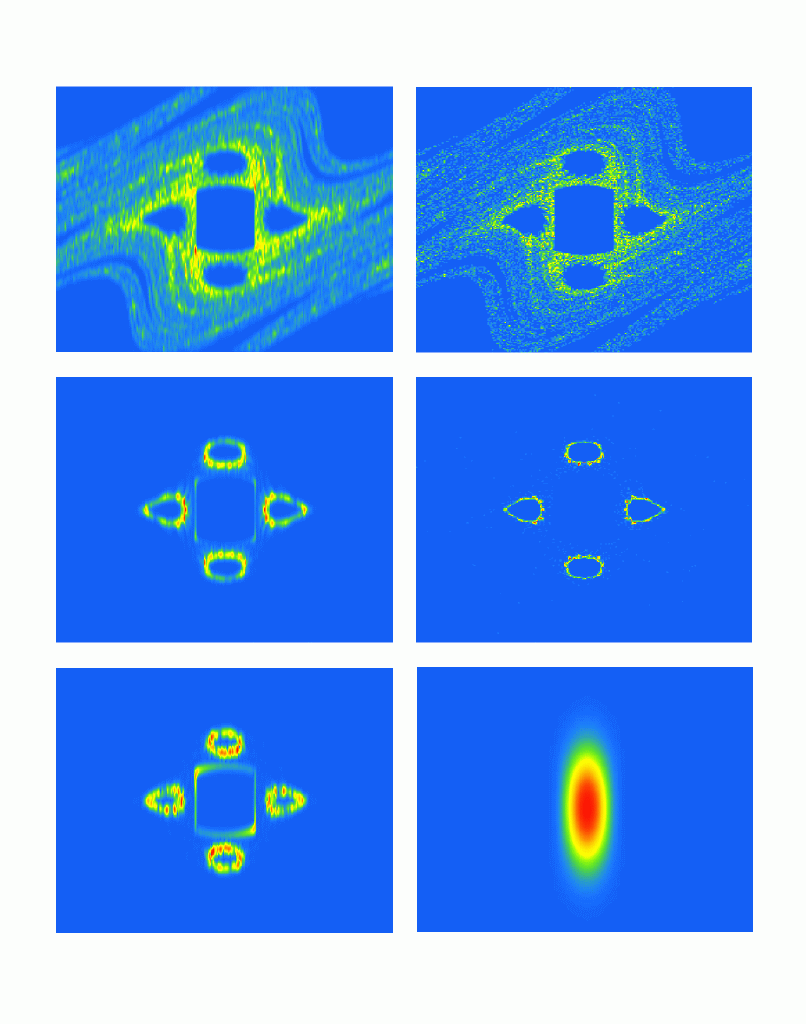
Poincare recurrences: quantum and classical fractals
Quantum Husimi function in the kicked rotator
with absorption at time t=100 (top left);
5000 (middle left), 3x10^5 (bottom left);
right top (t=100) and middle (t=5000) are
classical probabilities,
number of levels N=3^8 , kick strength k=N/4,
chaos parameter K=7;
right bottom shows Husimi function
for N=3^6, t=10^7.
From Ref. 100 (Phys. Rev. Lett. 82 (1999) 524)
http://xxx.lanl.gov/cond-mat/abs/9807145
|
|
|
|
|
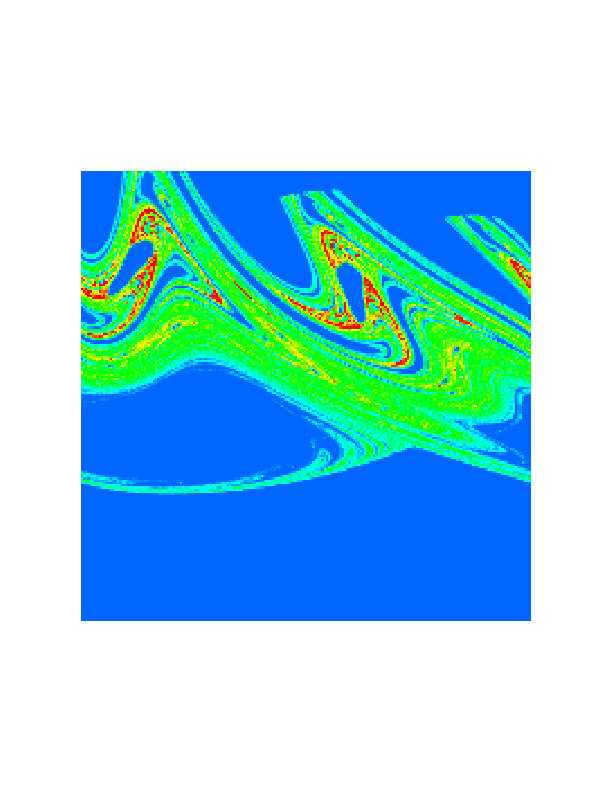
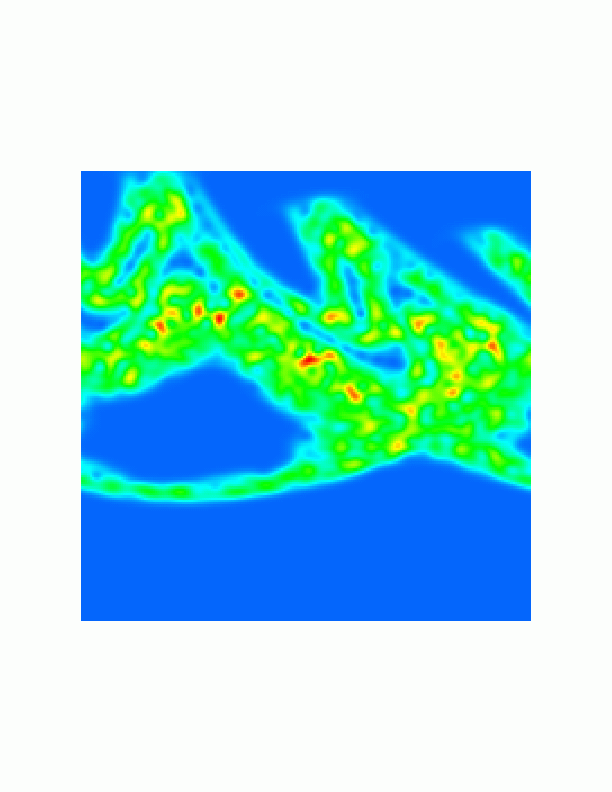
Quantum
fractals in hydrogen atom
Probability distribution in action-phase
plane (y,x) for classical (left) and quantum (right)
atom in a microwave field after 50 microwave
periods, initial level n=1200.
From Ref. 108 (1999)
http://xxx.lanl.gov/abs/cond-mat/9911200
|
|
|
|
|
|
|
|
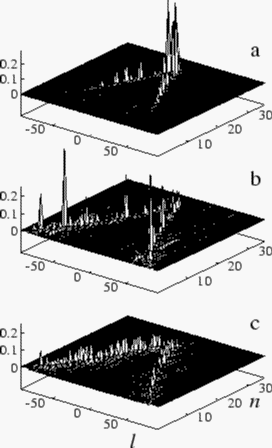
Quantum ergodicity in rough billiards
Transition from localization to Shnirelman ergodicity
on energy surface (n,l) for level number N =2250, l_max=95
and M=20; shown are the absolute amplitudes
of one eigenstate: a) localization for D=20,
b) Wigner ergodicity for D=80 and
c) Shnirelman ergodicity for D=1000.
From Ref. 92 (Phys. Rev. Lett. 79 (1997) 1833)
http://xxx.lanl.gov/abs/cond-mat/9807145
|
|
| |