


|
|
|
|

|
|

|
1.
Toulouse
(UPS) Key persons: B.Georgeot,
D.L.Shepelyansky
(network coordinator)
2.
Darmstadt
(TUD) G. Alber (node leader)
3. Univ. dell Insubria,
Como (INFM) Key persons: G.Benenti,
G.Casati (node leader)
4. Royal Holloway,
Univ. of London (RHUL) R.Schack
(node leader)
The aim of this project is the investigation of decoherence
and error correction in quantum processors solving physical
problems for which new and useful results may be achievable using
40-60 qubits. New algorithms will be developed for these problems,
which will include complex quantum dynamics, nonlinear classical
evolution, electron transport in disordered materials and metal-insulator
transitions. A numerical code package will be developed to simulate
these new algorithms and to model decoherence and imperfection effects
for realistic quantum computers with up to 30 qubits. Using this code
package, decoherence time scales and critical thresholds for multi-qubit
residual imperfections will be determined. Quantum error-correcting
codes will be tested with this package to reduce these decoherence effects
in the specific algorithms developed within this project.
- decoherence time scales for noisy gates and
dissipative coupling to environment
- universal laws for many-body chaos and fidelity
drop induced by static imperfections
- efficient quantum algorithms for computationally
hard physical problems
- numerical code package simulating new algorithms
with up to 30 qubits
- numerical tests of quantum error correction
codes
- stability bounds for the operability of realistic
quantum processors
|
|
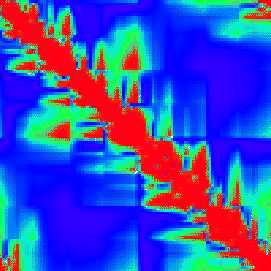
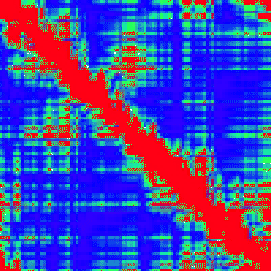
Matrix elements of a dynamical system based on the quantum wavelet transform
in the computational basis on a quantum computer with 12 qubits. Left:
perfect computer; right:computer with moderate static imperfections
 .
.